

Budapest’s Chain Bridge stands as a monumental symbol crossing the blue Danube, connecting Buda and Pest with grace and strength. This suspension bridge, steeped in rich history and remarkable engineering, beckons travelers intrigued by architectural craftsmanship and grand urban design. Whether you arrive from Budapest Airport, the railway stations, or venture out from the city center, the Chain Bridge is an accessible gateway to Hungary’s capital’s layered past and vibrant present. Embark on a journey along cobblestone paths, framed by lion statues and iron chains, to witness one of Central Europe’s most beloved crossings.
Table of Contents

Making Your Way to Chain Bridge Budapest
Getting to the Chain Bridge is straightforward no matter where you start in Budapest. From the city center, a pleasant walk leads you through bustling streets and into the historical heart of the city.
- If you arrive at Budapest Airport, take the 100E bus direct to Deák Ferenc tér, a central transit hub. From there, it’s a 10-minute walk to the Chain Bridge’s Pest side entrance.
- Travelers coming by train at Keleti or Nyugati stations can catch Metro line M3 or M2 to Deák Ferenc tér. Enjoy a scenic walk across the bridge or opt for tram lines 2 or 19, which stop close by with views of the river.
- For those already in Budapest’s city center, a stroll along the Danube promenade naturally leads to the Chain Bridge, a perfect blend of urban morphology and historic atmosphere.
Nearby accommodations range from elegant boutique stays with Danube views to simpler guesthouses nestled in vibrant neighborhoods. After crossing, savor traditional Hungarian cuisine at riverside restaurants offering goulash or chimney cake, perfect for a mid-visit break.
The Architectural Poetry of Chain Bridge
Designed by English engineer William Tierney Clark in the 1840s, the Chain Bridge was the first permanent connection between Buda and Pest. Its suspension design, featuring iron chains balancing the roadway, marked a revolutionary step in bridge engineering. The bridge’s stone lions at each entrance, carved with exquisite detail, welcome passersby with silent guardianship.

The bridge’s neoclassical elements harmonize with its robust iron structure, creating a balance of form and function. It gracefully reflects the Industrial Age’s embrace of new materials while respecting classical proportions and ornamental restraint. The Chain Bridge stretches approximately 375 meters, its chains tensioned to offer both support and visual lightness, an elegant metaphor for unity across the Danube’s divided banks.
Historical Transitions and Conservation
Throughout its history, the Chain Bridge witnessed key events in Hungary’s national story. It was damaged during World War II and reconstructed in the late 1940s, with careful attention to original details and materials. Today, it stands both as a functional crossing and a preserved monument, maintained through meticulous architectural conservation efforts.
Its reconstruction symbolizes resilience, blending the craftsmanship of the 19th century with modern techniques. Walking across, one senses the layers of history embedded in every stone and metal link.
Best Times and Tips for Visiting Chain Bridge
To appreciate the Chain Bridge’s grandeur and the Danube’s serene flow, timing your visit can enrich your experience.
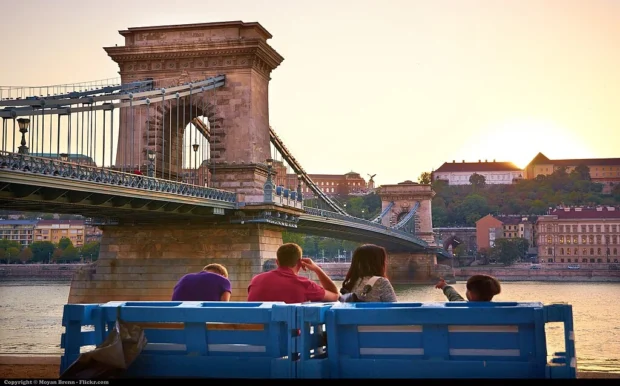
- Early mornings offer quiet moments with soft light ideal for architectural photography, capturing the intricate ironwork and stone carvings without crowds.
- Evenings bring a captivating transformation as the bridge’s illumination outlines its structure against the night sky, framing views of the Parliament and Buda Castle.
- Weekdays tend to be less crowded, allowing leisurely walks and unhurried contemplation of the bridge’s design elements.
- During local festivals or holidays, the bridge may host light shows or events, adding a festive atmosphere but potentially limiting access.
Visitors should allow time to pause and absorb the textures of the masonry, the rhythm of the chains, and the expansive river vistas. Comfortable footwear is recommended given the cobblestone pathways and pedestrian zones.
For travelers interested in historic city landmarks, the Spanish Steps in Rome offer another splendid architectural experience blending urban vitality with elegant design.
Guided Tours and Reservation Suggestions
While crossing the Chain Bridge requires no ticket or reservation, guided tours offer valuable insights into its design, history, and role in Budapest’s urban layout. Many tour operators provide walking tours that include the bridge alongside other architectural highlights such as Buda Castle or the Parliament Building.
For those with a keen interest in engineering or historic urban planning, specialized tours delve into the bridge’s construction techniques and material craftsmanship. Advance booking is advisable during peak travel seasons.
Self-guided exploration is also rewarding. Informational plaques along the bridge’s walkway shed light on artistic and structural details, perfect for curious minds eager to understand the synthesis of neoclassical aesthetics and 19th-century engineering innovation.
Nearby Delights and Local Flavor
Beyond the bridge itself, the surrounding districts offer rich experiences. On the Buda side, winding streets lead to hilltop vistas and cozy cafés serving Hungarian pastries and strong coffee. The Pest side boasts lively markets where fresh produce and artisanal products provide a gustatory map of the region.
Bratislava’s charming Old Town and hilltop castle offer a peaceful riverside contrast, perfect after visiting Budapest’s Chain Bridge. Wander Bratislava’s historic streets to enjoy a quieter Danube experience.
Sampling dishes like lángos—a deep-fried dough treat topped with sour cream and cheese—or savoring a hearty plate of pörkölt (stew) at local eateries enhances the cultural immersion. These flavors complement the architectural feast provided by the Chain Bridge’s environment.
Official Resources for Chain Bridge Information
For the latest updates on maintenance, events, and tour options, the Budapest city portal offers reliable details. Visit the official Budapest tourism website to plan your visit with confidence and discover complementary excursions around the city.
Right across the Danube, the Budapest Parliament Building showcases neo-Gothic beauty and national history, complementing your Chain Bridge visit. Learn about its grandeur here.
- Budapest Chain Bridge (31600041191) by Jorge Franganillo from Barcelona, Spain on Wikimedia Commons – cc by 2.0
- Budapest Szechenyi lanchid R01 by Marc Ryckaert (MJJR) on Wikimedia Commons – cc by 3.0
- Budapest – Széchenyi Lánchíd (26706202689) by Fred Romero from Paris, France on Wikimedia Commons – cc by 2.0
- Chain bridge at sunset from the right bank of Danube, 2012 Budapest (8082258970) by Moyan Brenn from Italy on Wikimedia Commons – cc by 2.0
.jpg)

.jpg)
.jpg)