

Corfu, a vibrant island in the Ionian Sea, welcomes visitors with a rare blend of Greek and European influences. Its sunny streets offer more than just postcard views; history here is lived in everyday life, from Venetian palaces to the faint scent of orange blossoms drifting on the breeze. Walking through Corfu feels like meeting Europe and Greece at a crossroads, where centuries-old traditions, stunning blue waters, and warm community life create a destination that stands out on any map. For those searching for memorable Greek islands, Corfu always appears among the best places to visit thanks to its UNESCO sites, rich cuisine, easy access, and welcoming spirit.
Table of Contents
Corfu Old Town’s Timeless Streets
My first day began at Corfu Old Town, the historic heart of the island and a UNESCO World Heritage Site. Walking along its cobbled lanes, I immediately noticed the pastel-colored buildings that felt more Italian than Greek, a remnant of Venetian rule. Clotheslines zigzag between houses, shutters hang open, and locals pause for friendly greetings of “Kalimera” in the narrow alleyways. The grand arches of the Liston Promenade—inspired by Paris’s Rue de Rivoli—anchor the town’s main square, Spianada. As children played soccer nearby, I admired how locals and visitors share these shaded rows of cafés, where you’ll find fresh baklava, strong Greek coffee, and midday laughter in the air.
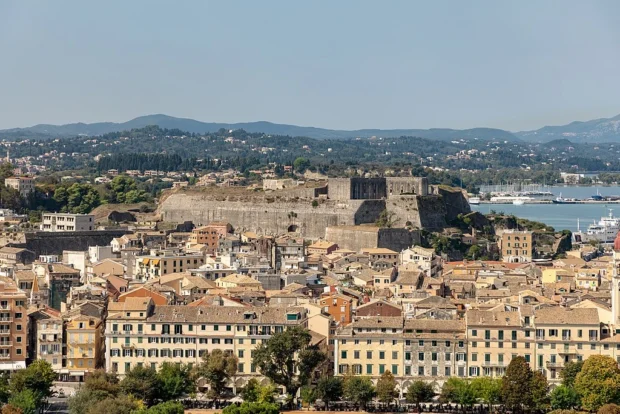
Standing at the edge of Old Town, the Corfu Fortress rises up, its thick stone walls once a defense against pirates and empires. I crossed the bridge into its cool shadows, imagining guard patrols and the echo of footsteps centuries ago. Looking out from its ramparts, the tiled rooftops and endless sea appear, making it clear why everyone from Romans to Venetians wanted Corfu.

Paleokastritsa: Cliffs, Beaches, and Monastery Peace
On the west coast, Paleokastritsa is beloved for its wild natural beauty. I took the public bus from Town a comfortable ride with hillside views dotted by olive groves. Paleokastritsa’s legend says Odysseus landed here after being shipwrecked, and the rocky landscape feels every bit as mythic. Crystal-clear bays shimmer beneath green headlands, inviting a swim in water so blue it looks painted. Renting a small paddle boat, I drifted in silence as fish darted below. Above, the 13th-century Paleokastritsa Monastery welcomes visitors with fragrant gardens and soft bells. Inside, dark icons and the gentle hum of prayer provide a space for reflection, whether you are religious or not.
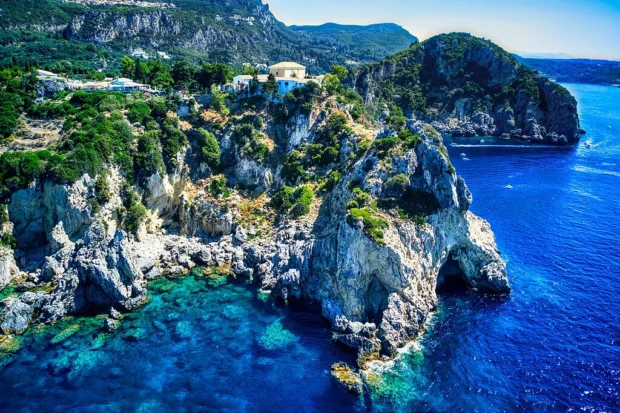
Lunch in this area is often fresh-caught octopus or grilled sardines served with lemon and olive oil, best enjoyed seaside, where the views are almost a meal themselves. I learned to say “Efharisto” when thanking the cook, a phrase that always brought a bright smile. Paleokastritsa’s beaches, like Agios Spyridon, are sandy and pebbled so bring swim shoes for comfort.
Achilleion Palace: Mythology and Grandeur
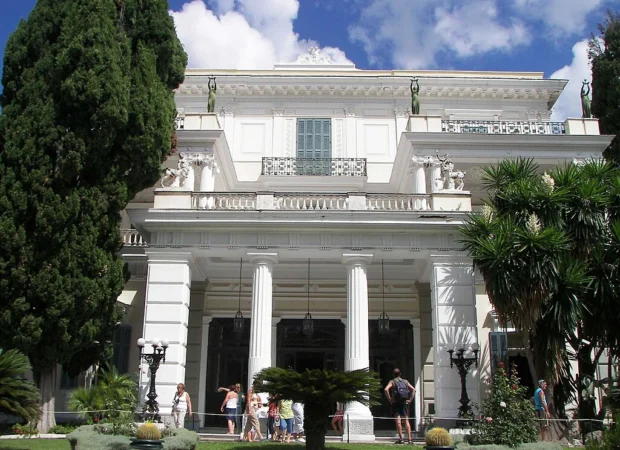
Not far from Corfu Town, Achilleion Palace stands as an ode to ancient Greek myths and royal tastes. Empress Elisabeth of Austria, also known as “Sisi,” built it in the 19th century to honor Achilles, her favorite Greek hero. I walked through the palace gardens, lined with statues of gods and heroes. No statue is as commanding as Achilles himself, standing tall at the center, an image of beauty and strength. Inside the palace, frescoes and marble floors recall the faded luxury of European royalty, always with the Ionian waters sparkling in the distance. Guides explained how Empress Elisabeth found peace here, escaping her courtly troubles. Even with crowds in summer, it’s easy to see why.
Corfu Town Squares and Daily Life
Back in town, Spianada Square is Europe’s largest square, and every evening, you see whole families walking after dinner. It is the heart of Corfu’s social life cricket matches sometimes fill the grassy center, a legacy of British rule. Around the square, music spills from small bands, and older men play chess under the colonnades. During festivals, the square hosts parades and concerts, where I heard the melodic Greek phrase “Yia mas!” as people clinked glasses in celebration. The architecture is grand but welcoming; there is little separation between locals and the curious visitor.
Nearby, the Corfu Archaeological Museum houses artifacts from ancient temples and palaces rare gold jewelry, painted pottery, and a lion sculpture dating back 2,500 years fill the rooms. For anyone interested in Greek or Mediterranean history, each piece here tells an unexpected story of cultural fusion. If time allows, I recommend stepping into this cool, quiet space even for a short visit.

Religious Sanctuaries: Vlacherna, Kanoni, Pontikonisi
Perhaps Corfu’s most famous image is the small white Vlacherna Monastery, floating above the shimmering lagoon and connected to land by a narrow causeway. Arriving early in the morning, I watched fishermen untangle their nets while monks in simple robes walked the island’s paths. Not far away is Kanoni, from where you can take the perfect photo: the monastery framed against the deep blue sea, with Pontikonisi Mouse Island in the background. Small boats ferry visitors across to Pontikonisi, which, according to legend, is the petrified ship of Odysseus. The scene is peaceful, the air scented with pine, and all around you hear “Yassas” a friendly hello on the island.

It’s easy to spend an hour or more just watching planes landing at the nearby airport, arriving just overhead. This quirky sight surprises many first-timers, as the airport’s runway nearly touches the lagoon. Despite the gentle buzz of planes, tranquility dominates, and the reflections of the white monastery never grow dull.

Mon Repos and the Island’s Green Spaces
Corfu loves its gardens, and none is more famous than Mon Repos Palace. Built for British governors in the 1800s, it later became the birthplace of Prince Philip. Walks here are shaded by tall cypresses and ancient plane trees, offering relief from summer sun. In spring, wildflowers and singing cicadas fill the paths. Occasional peacocks strut across lawns, watched by locals picnicking in the grass. Mon Repos also holds the ruins of an ancient temple, layers of history that still shape daily life. In this setting, the gentle rhythm of “Parakalo” a polite way to say please makes interactions feel softer and more welcoming.

Corfu’s Regional Cuisine and Dining Etiquette
One cannot write of Corfu without speaking of its food. The island’s cuisine features a rich blend of Greek and Italian flavors. In Campiello, the old Jewish quarter, I found family-run tavernas serving sofrito (beef cooked in garlic and vinegar), bourdeto (spicy fish stew), and pastitsada (pasta with tomato and cinnamon-spiced beef or chicken). Each dish is a record of foreign influence Venetian spices here, British puddings there. Lunch often ends with kumquat liqueur, a local specialty made from the tiny, sweet-sour fruit grown on Corfu’s hillsides. Bread comes with olives, and it’s polite to wait until everyone has food at the table before starting to eat. Locals linger at the table, sipping coffee and sharing stories long after the meal finishes, and it’s seen as rude to rush or ask for the bill too quickly.
I learned to greet with a cheerful “Kalimera” in the morning, toasting friends with “Yia mas!” at dinner, and to offer a thank you with “Efharisto” wherever I ate. Eating is not just about food, but about the warmth and hospitality philoxenia that Corfiots share with each guest.
Transport: How to Get Around Corfu
Arriving in Corfu is simple, with the airport located just a short ride from Old Town. Blue city buses connect the airport and ferry port with the town center, running frequently check signs or ask, “Pou ine o stathmos?” if you need the bus stop. For longer trips across the island, green buses travel to Paleokastritsa, Achilleion, and beyond, offering reliable and affordable service. Riding alongside locals is a good way to learn a few words and see fields and villages you might miss otherwise. Renting a bicycle or scooter is popular in summer, but many roads are narrow and can be hilly, so some patience is needed. Public transport is efficient, and using it leaves more time to enjoy coffee and company on shaded squares rather than looking for a parking space.
Corfu’s Traditions, Festivals, and Everyday Customs
The Corfiot calendar is full of festivals, from Carnival in February, celebrated with masks and parades, to August’s Assumption Day, when villages fill with music and feasting. Easter is the most important celebration; the town erupts with church bells, midnight fireworks, and the famous pot-breaking ritual. At this event, locals drop clay pots from windows into the street, a tradition said to bring good luck. Walking these streets, I noticed how neighbors call out “Kalimera” to everyone a habit that instantly makes visitors feel included.
Church bells mark the passage of the day, while music often brass bands sounds during parades and holidays. Old men play tavli (backgammon) in cafes, and people gather in the evening to chat until late at night. Though Corfu is lively, respect for elders is important. It’s good manners to greet older people with a nod or a soft “Herete.” Entry to churches requires covered shoulders, and in villages, strangers are often offered a cool drink or a piece of fruit an old gesture of respect and welcome. It’s best not to refuse; even a small bite or sip is appreciated.
Final Thoughts: Postcard Moments and Community Spirit
What makes Corfu unique is how it invites you not only to see its past but to participate in living traditions. From the echo of distant bells in sleepy side streets to the laughter rising above glasses at a late-night taverna, the island rewards those willing to slow down and look closer. There are always new details to notice—a chipped tower in the fortress fishermen mending nets at dawn, a sudden burst of music when least expected.
One afternoon, I watched a group of children play football on Spianada, just as they have for generations, while a grandfather told stories in the shade. The old and the new live side by side. Whether seeking history, cuisine, or just the gentle pace of everyday Greek life, Corfu is open-hearted and unforgettable.
For travelers enjoying Corfu’s rich culture, a visit to Berlin reveals a different historic charm and modern energy worth discovering Berlin’s Landmarks and Life.
Traveler exploring cultural intersections, sharing reflections on similarities and differences between traditions, lifestyles, and food.
- Corfu Faliraki R02 by Marc Ryckaert (MJJR) on Wikimedia Commons – cc by 3.0
- Korfu (GR), Korfu, Altstadt — 2018 — 1113 by Dietmar Rabich on Wikimedia Commons – cc by-sa 4.0
- Corfu Old Fortress R02 by Marc Ryckaert (MJJR) on Wikimedia Commons – cc by 3.0
- MoniPalaiokastritsasCorfuJuly142022 by Hagai Agmon-Snir حچاي اچمون-سنير חגי אגמון-שניר on Wikimedia Commons – cc by-sa 4.0
- Achilleion in Kerkyra by No machine-readable author provided. Tasoskessaris assumed (based on copyright claims). on Wikimedia Commons – cc by-sa 3.0
- 20180523 Greece 5266 Corfu Town sRGB (43744570042) by Dan Lundberg on Wikimedia Commons – cc by-sa 2.0
- Corfu Vlacherna R02 by Marc Ryckaert on Wikimedia Commons – cc by 3.0
- KanoniCorfuGreece by George82p on Wikimedia Commons – cc by-sa 4.0
- Pontikonisi Island 05-06-06 by Sascha Askani on Wikimedia Commons – cc by-sa 3.0

,_Korfu,_Altstadt_--_2018_--_1113.jpg)


.jpg)


