

Bogota is not what most people imagine. It rises from the Andes like a half-forgotten city in the clouds, sprawling and busy, with mountain winds chasing street vendors and children through stone plazas. Exploring Bogota is to understand Colombia’s past and present, its contradictions and its everyday life. If you have heard of Colombia as a place of color, change, and hidden beauty, Bogota is where those ideas become real. From the moment I arrived fresh from the airport and blinking in the high-altitude sunlight I felt the city’s pulse in the cold mountain air and saw it in every mural, every arepa de choclo, every plaza full of pigeons and laughter.
Table of Contents
First Impressions: Arrival in Bogota’s Mountain Air
El Dorado International Airport sits on the western edge of the city, and arriving here feels like opening a novel mid-chapter. Bogota is high over 2,600 meters above sea level which surprised me instantly. The air is cool, sometimes thin, always awake. I took the TransMilenio bus, which cuts through the traffic in its own dedicated lanes, straight to the city center. It is fast, sometimes crowded, and gives you a first look at how the city breathes and moves. If you come during rush hour, prepare for a sea of faces, students, businesspeople, and families, each with their own quiet destination.
Here, mountains are never out of sight. They rise like stone guardians behind the eastern edge of the city, and at sunset, the light over Bogota is copper and gold. The city is not always beautiful in the postcard sense much of it is grit, graffiti, and the hum of everyday life but its imperfect charm is what hooked me from the start.
Monserrate: Bogota’s Mountain and Sacred Heart
Monserrate is the symbol of Bogota, whether you’re a tourist or a local. The first time I saw its white church and radio towers way above the city, it reminded me of how religion and landscape meet in unexpected ways here. You can walk up joining crowds of pilgrims and exercise lovers on the stony path or take the funicular train, which climbs so steep it feels like a roller coaster for the devout. Either way, at the summit, you see Bogota spread out like a patchwork quilt: red roofs, green parks, and the gray of modern high-rises.

Locals say that many couples become engaged on Monserrate, and there are often flowers for sale near the top. There’s food too, from classic chocolate con queso (hot cocoa with salty cheese to dunk) to more daring snacks like obleas, a thin wafer filled with caramel and jam. At the summit, I watched a storm roll over the city and listened to a guide explain how countless lovers have scratched their names into the rails over the years each believing love, like Bogota, is meant to last on a mountain.
Paseo Through La Candelaria: History, Art, and Stories
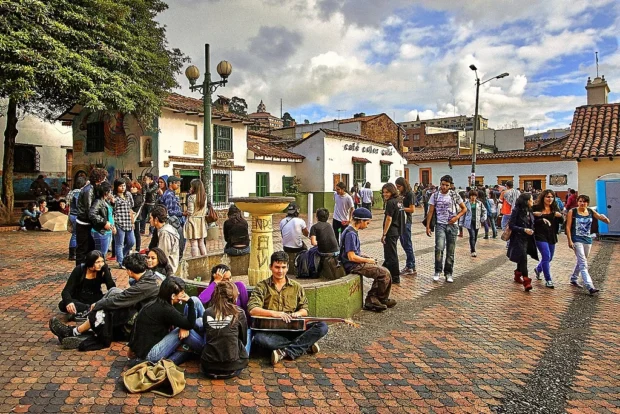
La Candelaria is Bogota’s historic district, and walking here is like wandering through a centuries-old painting that someone keeps adding to. The houses are painted in sun-washed colors jade, ochre, deep blue and their wooden balconies lean over narrow streets. Graffiti is everywhere, but it is more than spray paint: it is storytelling, protest, declaration, and pride.
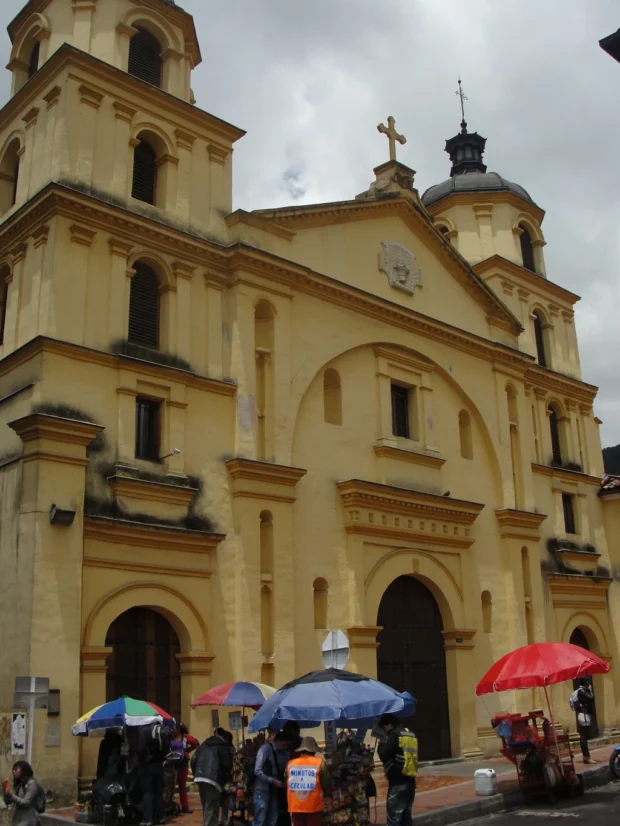
I spent an afternoon here, stopping first at Chorro de Quevedo. They say this is where Bogota was founded, and whether that is true or not, the square brims with poets, students, and street performers. The echo of history lives in every sip of chicha (a fermented corn drink that left my lips tingling and my head a bit fuzzy definitely an acquired taste). Around the corner, the Church of San Francisco sits quietly a 16th-century reminder of faith and survival, the oldest church in the city, nearly unchanged since conquistadors passed these streets.
Gold Museum: the Real El Dorado Shines Here
People come to Colombia dreaming of gold, and the Museo del Oro is the true “El Dorado.” Entering here is like stepping into a treasure chest the size of a city block. There are more than fifty thousand gold pieces inside delicate funerary masks, nose rings, and animal figurines, some so intricate it is hard to imagine ancient hands made them.

I joined a school group near a display of golden boats, watching their faces light up as a guide explained how these treasures were once thrown into lakes as offerings. I learned that gold was rarely about wealth for ancient Colombians it was sacred, connecting people and gods. The star of the collection is the Muisca Raft: a tiny sculpture showing a chief, his followers, and offerings. Sometimes you can hear a gasp as people realize this is the heart of the legend of El Dorado. As I left, a local woman reminded me, with a smile, “The gold belongs to all Colombians, but here it is safe for the whole world to enjoy.”
Botero Museum: Larger Than Life, Full of Spirit
The Botero Museum is nothing like any art museum I have ever visited. Fernando Botero’s paintings and sculptures fill the airy colonial mansion with big, bold, curving shapes. Everyone and everything in Botero’s world is round fat cats, wide-eyed bishops, still-lifes that burst from their frames. Some laugh, some look sad, but all seem to float between reality and imagination.

Admission is free, and you can see international masters (Picasso, Renoir) alongside unmistakably Colombian works. Kids love this place the statues are playful, nearly huggable. Adults whisper about the sly humor and hidden meaning. In the courtyard, I watched a couple argue softly about whether Botero’s figures are a joke or a celebration. My own opinion shifted; maybe they are both. The museum, like Bogota, doesn’t fit into just one box.
Plaza Bolívar: Birds, Politics, Everyday Life
Plaza Bolívar is the heart of Bogota, and everyone passes through sooner or later. The cathedral’s white columns rise above flocks of fat pigeons and blue-uniformed police. On one side is the old Capitol, on another the Palace of Justice, and in the middle, under Simon Bolívar’s statue, children chase each other between snack carts and occasional protests.

I sat on the cold stone for an hour, eating a slice of arepa stuffed with cheese, and watched as two teenagers sold birdseed to tourists. The pigeons, it seems, are as much citizens as anyone else here. Nearby, a group of musicians played vallenato on accordions, and an old man told me the square has seen everything poetry readings, protests, even folk festivals. “This place is the soul of Bogotá,” he declared, “no matter what changes.” When I looked closely, I noticed the stone steps are worn smooth from centuries of footsteps, and every corner has its own patch of history.
Living Layers: Neighborhoods and Unexpected Finds
If you wander north, Bogota changes character completely. In Usaquén, the weekend market bursts with handicrafts, food stalls, and the slow dance of bargaining. Here, I found handwoven bags, tasted tamales wrapped in banana leaves, and chatted (in very basic Spanish) with an artist painting local scenes. The neighborhood has colonial charm but a relaxed, modern air bars are lively, and on Sundays, families stroll with dogs while musicians strum guitars under leafy trees.
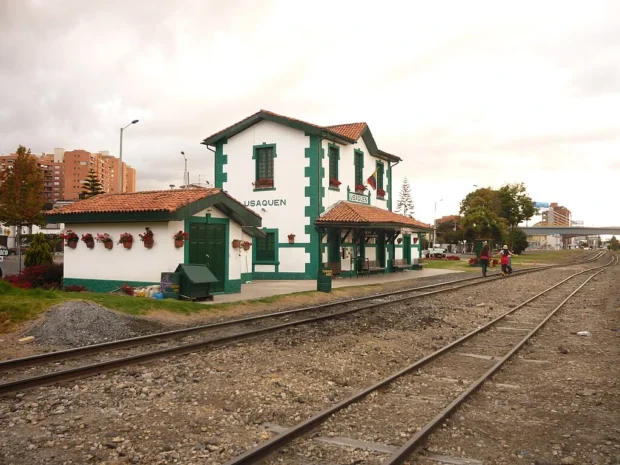
Further west, Parque de los Novios is popular with couples and friends. It is green and cool, with paddle boats and small lakes. I heard the laughter of families, the hum of teenagers skating, and the content silence of older men playing chess on shaded benches. At sunset, the city’s energy softens. The Simón Bolívar Metropolitan Park is much bigger, nearly a city in itself there are concerts, festivals, and kites flying over wide lawns all year long. Once, I stumbled into a flower festival in the Jardín Botánico: a riot of colors, smells, and dozens of hummingbirds darting through orchids.

For the Senses: Food and Street Scenes
Bogota’s food is as diverse as its people. My favorite breakfast was changua a soup of milk, eggs, and green onions that sounds strange but tastes like comfort on a chilly morning. In La Macarena, the restaurants spill onto the sidewalks, offering fusion dishes and classic Colombian plates. Ajiaco, a chicken and potato soup, is everywhere; it tastes best when eaten slowly, your breath fogging the window as rain taps the glass.
I loved the fruit stalls on nearly every corner. Vendors slice guanábana, lulo, papaya, and mango into sweet, fragrant cubes and laugh as children beg for extra salt or honey. In Usaquén, I tried arequipe (caramel) spread on soft bread, a simple treat that sticks to your memory as much as your teeth. Street food is lively: empanadas, bunuelos (cheese balls), and corn on the cob roasted over hot coals. Every flavor tells a story.
There are fancier places, too hillside cafes with city views, rooftop bars in Chapinero but I found the street food to be the heart of Bogota. Locals often ask about your favorite flavor; it’s their way of measuring friendship, I think.
Day Trip: Salt Cathedral of Zipaquirá
Leaving Bogota for a few hours, I joined a bus to Zipaquirá, about an hour north. The Salt Cathedral is not just a church it is an entire world carved underground from an old salt mine. You walk down a long tunnel, passing stations of the cross chiseled from the rock, until the giant central nave opens up. It feels quiet and otherworldly, a place where salt sparkles like stars. Some say the cathedral is a tribute to Colombia’s faith; others call it an engineering marvel. For me, it was both a reminder that beauty sometimes hides below the surface.

On the way back, I chatted with a group of university students, who explained how Zipaquirá’s salt financed buildings all over Colombia in the past. They shared local jokes apparently, eating salted potatoes is proof you visited and insisted I try a cup of thick hot chocolate. I returned to Bogota full, cold, and grateful for the advice.
Staying in Bogota: Comfort Between Contrasts
Where you stay in Bogota shapes your experience. The historical center (La Candelaria) is full of hostels and guesthouses inside old mansions, perfect for early-morning strolls and night walks among lantern-lit streets. In Chapinero, life is modern and lively, with coffee shops, art spaces, and a mix of students and professionals. Further north, accommodation is quieter, more residential, and close to parks like Parque de los Novios.
I found safety is mostly about knowing where to walk (and when). At night, I stuck to well-lit streets and kept valuables out of sight. Most locals reassured me common sense and friendliness go far in Bogota. Neighborhoods like Usaquén or Quinta de Bolívar are calm, almost village-like, and perfect for an evening stroll.
Getting Around: Buses, Bikes, and Curious Paths
Bogota’s public transport is a puzzle you learn while living it. The TransMilenio is the backbone red buses that zip past traffic in their own lanes. It can be crowded, but there is a satisfaction in joining the city’s rhythm, tapping your fare card, and hopping off at Plaza Bolívar, the National Museum, or any leafy park.
For shorter trips, bicycles are everywhere Bogota is proud of its ciclovía, miles of city roads closed to cars on Sundays for cyclists and runners. I borrowed a bike and joined thousands families, couples, elderly riders with baskets of flowers feeling like part of a moving festival. Walking is another pleasure, especially in La Candelaria and Usaquén, but watch out for steep hills and unpredictable weather: Bogota can change from hot to cold in minutes, and rain is never far away.
People, Traditions, and Everyday Life
Trust builds slowly in Bogota, but kindness is everywhere. People are formal at first greetings are important, and a handshake or a nod opens many doors. I learned that you should address elders as “Señor” or “Señora.” Accepting a cup of tinto (strong black coffee) is a gesture of friendship, and refusing can seem rude. Bogotanos pride themselves on being polite, sometimes reserved but once you share a laugh over street food, the distance melts.
Every Sunday, families gather in parks, children fly kites, and old men tell stories of how the city has changed. I often stopped to listen my Spanish slow, their patience endless. The city moves between tradition and change, between Catholic processions and street art festivals. Rituals matter: lighting a candle in the Church of San Francisco, eating buñuelos at Christmas, or joining strangers in applause after a street performance in Chorro de Quevedo.
Curiously, some buildings are painted every few months not only to cover graffiti, but as a way of claiming space and memory. “We keep painting because we keep changing,” a local teacher told me. Bogota is a city of constant reinvention, where every wall tells two stories one old, one new.
Closing Thoughts: Bogota’s Spirit Endures
Bogota is not a city that reveals itself all at once. Its beauty is layered sometimes rough, sometimes graceful, always honest. It is a place of mountains and markets, museums and noisy streets, where gold sits beside graffiti and tradition dances with progress. Whether you are watching the city from Monserrate’s summit or sharing empanadas with strangers in Plaza Bolívar, you will find moments that surprise and move you.
Discover how Bogota’s highland spirit compares to the historic vibrancy at the Plaza de Armas in Santiago, another lively Andean city center.
Come with open eyes and an open mind. Talk with locals, try a new dish, climb a hill or wander a market. Bogota’s story is not finished, and every traveler adds a little more to its pages. I left the city with new friends, a taste for hot chocolate and cheese, and a sense that even in the clouds, a city can feel like a home.
Explore the charm of another vibrant city in Asia by reading about Ho Chi Minh City’s pace and stories, a place where history and daily life quietly unfold beyond the buzz.
Traveler exploring cultural intersections, sharing reflections on similarities and differences between traditions, lifestyles, and food.
- BOGOTA CITY by KEVIN CASTAÑEDA VILLAMIL on Wikimedia Commons – cc by-sa 4.0
- Bogotá-Monserrate 2015 03 by Tefita228 on Wikimedia Commons – cc by-sa 4.0
- Iglesia y convento de La Candelaria (Bogotá) 02 by Racso (Oscar Fernando Gómez) on Wikimedia Commons – cc by-sa 3.0
- Bogota, Colombia (24271449223) by Pedro Szekely from Los Angeles, USA on Wikimedia Commons – cc by-sa 2.0
- BOG Museo del Oro by Felipe Restrepo Acosta on Wikimedia Commons – cc by-sa 3.0
- La Candelaria – Museo Botero (Bogotá) 01 by Racso (Oscar Fernando Gómez) on Wikimedia Commons – cc by-sa 3.0
- Plaza de Bolivar – Bogota – ANDREA GAETANO by Andrea Gaetano on Wikimedia Commons – cc by-sa 3.0
- Ferrocarril de la Sabana, Estación Usaquén, Bogotá, Colombia 06 by Juan Diego Santacruz on Wikimedia Commons – cc by-sa 3.0
- Parque de Los Novios, Bogotá, Colombia by Juan Carlos Sáenz Rodríguez on Wikimedia Commons – cc by-sa 4.0
- Zipaquira Salt Cathedral (9287350499) by Jonny Green on Wikimedia Commons – cc by 2.0


_02.JPG)
.jpg)

_01.JPG)


.jpg)