

Nestled atop Montmartre hill, the Sacré-Cœur Basilica stands as an emblem of Paris’s rich architectural tapestry and spiritual heritage. This white-domed monument draws visitors worldwide, intrigued by its stunning Roman-Byzantine design and panoramic views of the city. In this guide, we delve into the basilica’s creative intricacies, historical importance, and practical advice for making the most of your visit in Paris, France.
Table of Contents
Architectural Elegance of the Sacré-Cœur Basilica
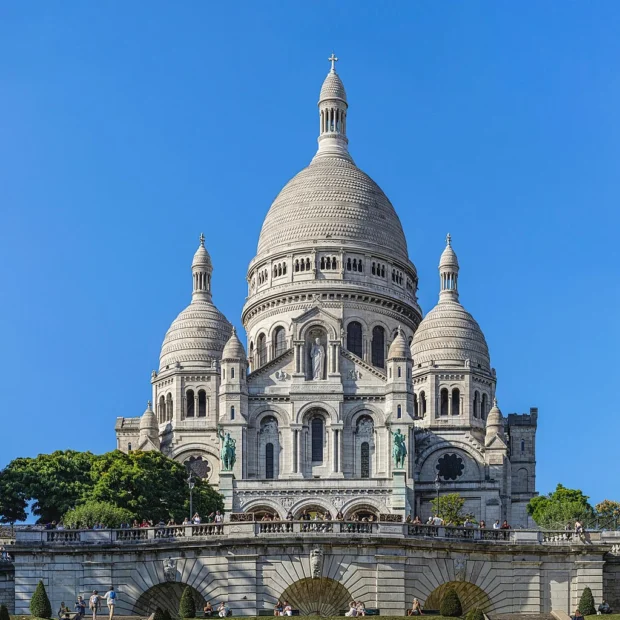
The Sacré-Cœur Basilica captivates with its gleaming white travertine stone, which exudes a subtle glow, often mistaken for marble at a glance. This choice of material not only lends the basilica its distinctive luminosity but also ensures a self-cleaning surface, as rainwater activates the stone’s calcite content to wash away dirt and pollution.
Its architectural style blends Romanesque solidity with Byzantine intricacy, an unusual synthesis that sets the basilica apart from Paris’s predominantly Gothic skyline. Noteworthy features include the large central dome crowned with a lantern, flanked by two smaller ones, which recall the grandeur of Eastern churches. The basilica’s interior reveals vast mosaics, including one of Christ in Majesty, spanning over 480 square meters, one of the largest in the world, demonstrating a mastery of craftsmanship and storytelling through tesserae.

Historical Layers and Spiritual Resonance
Commissioned in 1875 and completed in 1914, the Sacré-Cœur Basilica arose in response to France’s turbulent history – particularly the Franco-Prussian War and the Paris Commune uprising. It symbolized a spiritual renewal aiming to heal the fractured nation. Its dedication to the Sacred Heart of Jesus encapsulates a message of divine love and mercy, resonating deeply with visitors seeking solace or inspiration.

The basilica’s site holds earlier religious significance, formerly hosting a vineyard and a chapel dedicated to Saint Peter. Interestingly, it stands opposite the Moulin Rouge cabaret, offering a stark contrast between sacred and secular energies that characterize Montmartre’s bohemian past.
Getting There and Nearby Comforts
Reaching Sacré-Cœur is an experience in itself. The nearest metro station is Anvers on Line 2, a short walk through lively streets leads you to the base of Montmartre hill. Alternatively, the funicular railway offers a charming ascent for those wishing to avoid the 300-step climb. From Gare du Nord, a central railway hub, the metro journey is approximately 15 minutes, making Sacré-Cœur easily accessible for day visitors or travelers arriving by train.
For those coming directly from Charles de Gaulle Airport, the RER B line connects to Gare du Nord, where transfer to metro Line 2 is possible. Taxi rides typically take around 40 minutes depending on traffic.
Accommodation options abound near Montmartre, ranging from quaint guesthouses to boutique apartments, all offering proximity to the basilica’s creative atmosphere. After your visit, sampling local cuisine in neighborhood bistros is a must – try classic French dishes like coq au vin or escargots, with many eateries featuring terraces ideal for people-watching.
Visitor Insights and Best Times
To appreciate the basilica’s architecture without crowds, aim for early mornings on weekdays, especially outside peak tourist seasons (spring and autumn are particularly pleasant). The soft morning light enhances the travertine’s texture and highlights the sculptural details on the façade.
Evenings offer a different charm; the basilica is beautifully illuminated, and the view over illuminated Paris from the front steps creates a magical tableau. However, note that the basilica closes at 10:30 pm, so plan accordingly.
Entry to the basilica is free, but guided tours are available for those eager to delve into the artistic and symbolic elements in depth. Reservations can be made via the official website to secure a spot. The dome’s summit requires an additional ticket and a climb of narrow steps, but rewards visitors with one of Paris’s most breathtaking vistas.
What to Bring and Wear
- Comfortable shoes for walking and climbing steps
- Modest attire for respecting the sacred space
- A lightweight scarf or jacket as the basilica’s interior can be cool
- A camera to capture architectural details and city panoramas
Subtle Myths and Overlooked Details
While many focus on the basilica’s visual grandeur, subtle myths weave through its stones. One tale holds that the basilica’s dome inspired the design of the United States Capitol dome, sparking an architectural dialogue across continents. Another fascinating detail is the mechanical chime system in the bell tower, which houses the Savoyarde, one of the world’s heaviest bells, weighing over 19 tons.
Visitors often miss the exquisite craftsmanship of the iron gates and the intricate mosaics in the crypt, which offer quieter reflections away from the bustling crowd. Such features underscore the artisans’ dedication to both grandeur and intimate sanctity.

Official Information and Booking
For up-to-date information on opening hours, tours, and special events, consult the basilica’s official website. It provides practical guidance, event calendars, and options to reserve guided visits and dome climbs.
You can visit the official site by clicking Sacré-Cœur Basilica Official Site.
Final Reflections on Visiting Sacré-Cœur
The Sacré-Cœur Basilica invites contemplation not only through its physical presence but also via its embodiment of faith, national resilience, and artistic innovation. Its blend of architectural styles narrates a chapter of history rooted in both conflict and hope. The journey up Montmartre hill and the panoramic views offer moments of pause amid Paris’s urban rhythm. Every detail, from stonework to stained glass, speaks of human creativity’s enduring power. A visit here enriches appreciation for architecture’s role not just as shelter, but as a storyteller, a beacon, and a sanctuary.
To complement your visit to Sacré-Cœur, discovering the Palace of Versailles offers insight into France’s grand royal architecture just outside Paris.
- Basilique du Sacré-Cœur.001 – Montmartre by Fernando Losada Rodríguez on Wikimedia Commons – cc by-sa 4.0
- Basilique du Sacré-Cœur de Montmartre – Paris – GT-01 – 2024 by Terragio67 on Wikimedia Commons – cc by-sa 4.0
- Paris Basilique Sacré-Coeur Kuppel 1 by Zairon on Wikimedia Commons – cc by-sa 4.0
- Christ in Majesty in Basilique du Sacré-Cœur de Montmartre, 12 August 2013 by Shadowgate from Novara, ITALY on Wikimedia Commons – cc by 2.0
- Paris, Sacré Coeur, Innenansicht (2) by Cmcmcm1 on Wikimedia Commons – cc by-sa 4.0


.jpg)